
Slit lamps
SL 650 / SL 650+
Digital slit lamp with HD imaging, upgradeable to a complete dry eye assessment
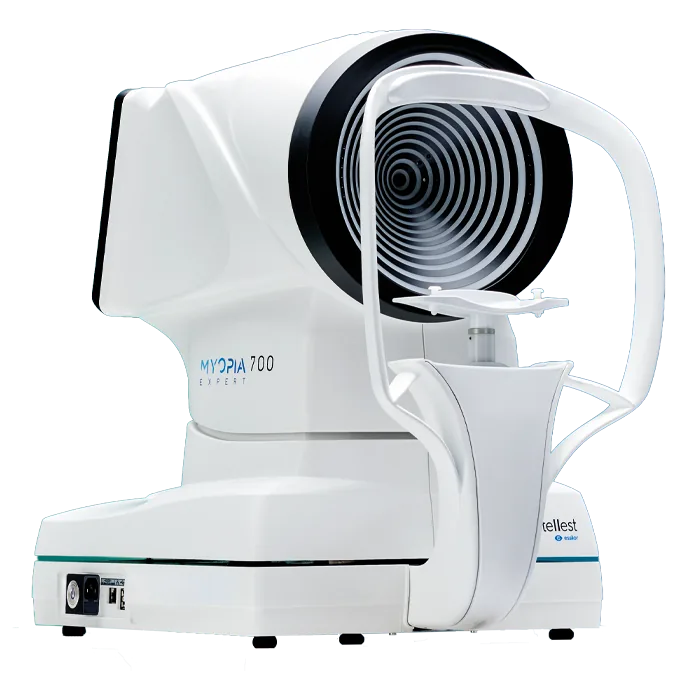
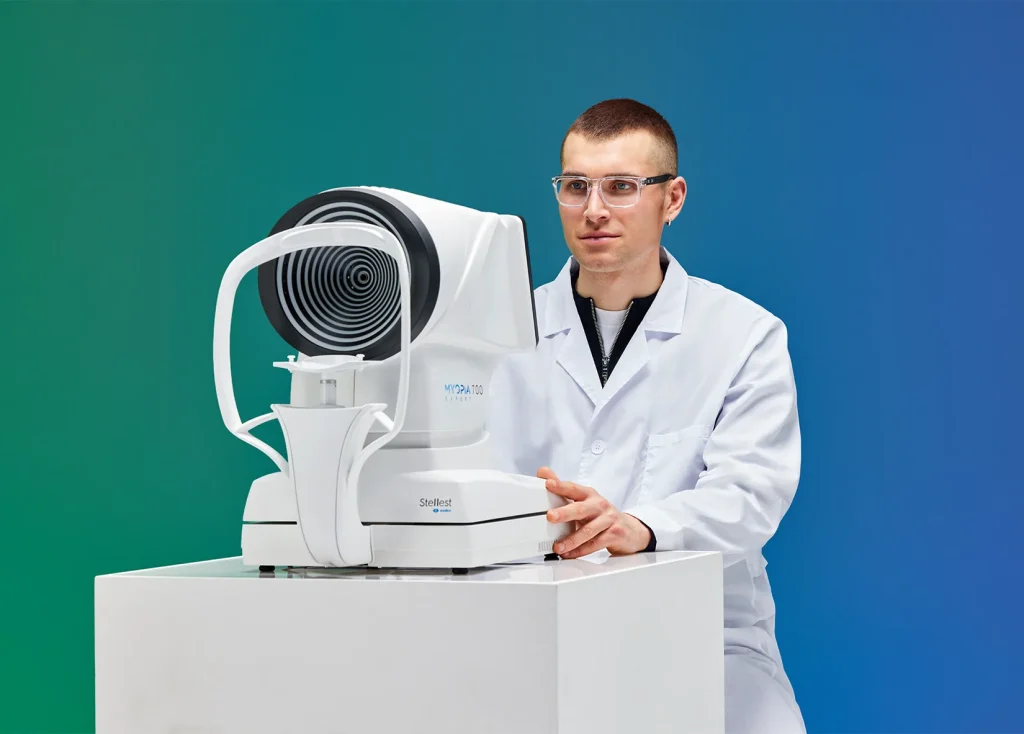
Optical biometer and topographer for confident myopia management
EU MDR Class IIa medical device. For professional use only.
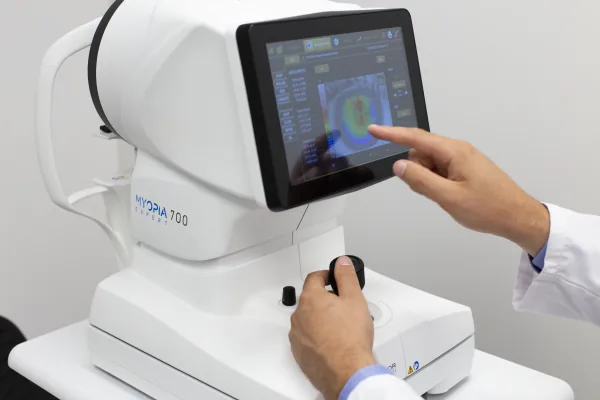
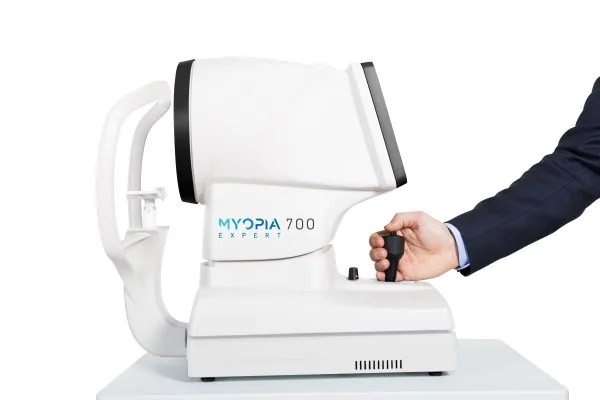
Myopia Expert 700 is an optical biometer and corneal topographer for eye care professionals who run a myopia management service. It measures axial length by low coherence interferometry and maps the cornea with a 24-ring Placido cone, so one instrument gives the data needed to choose, fit and monitor a myopia control solution. Measurements are non-contact and need no anaesthesia, which keeps the experience comfortable for children and lets the practitioner start the conversation with parents early, backed by objective numbers.
Axial length is a key clinical indicator in myopia management. The International Myopia Institute recommends a myopia follow-up exam every six months, and a change of around 50 µm between two visits can indicate progression.
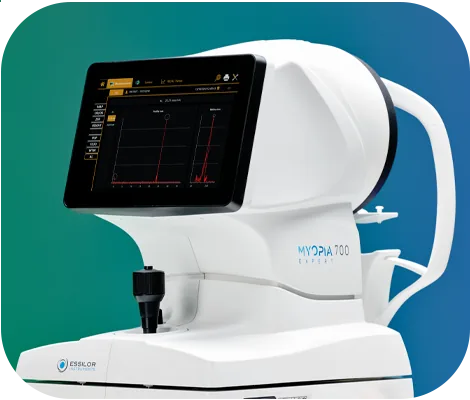
Myopia Expert 700 captures the measurements used across different myopia control options with a single instrument:
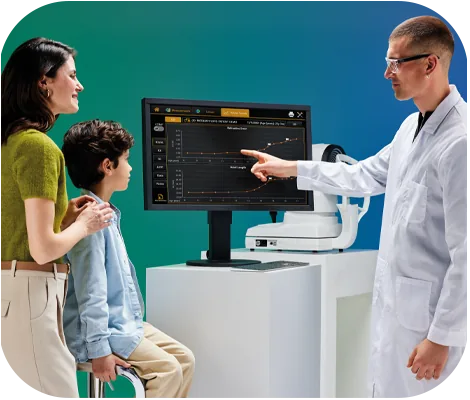
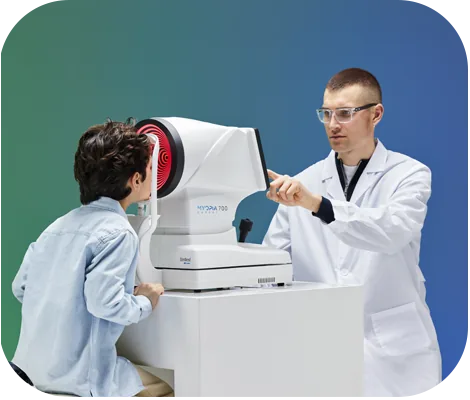
A fast, guided process gives a smooth experience for both practitioner and patient. Complete acquisitions take a few seconds, the guided focus system helps the operator, and nothing touches the eye. The instrument runs on an embedded Windows PC with integrated LAN and two USB ports, so results fit into the practice workflow. Combined with myopia control spectacle lenses such as Essilor Stellest, it supports a structured approach to correcting myopia and monitoring progression.
| Axial length method | Low coherence interferometry |
|---|---|
| Keratoscopic cone | 24 rings equally distributed on a 43 D sphere |
| Analysed points | Over 100,000 |
| Measured points | Over 6,000 |
| Corneal coverage | Up to 9.8 mm on a sphere of radius 8 mm (42.2 D, n = 1.3375) |
| Focus system | Guided focus |
| Pupillometry | Infrared LEDs plus white LEDs for photopic acquisition |
| Fluorescein | Blue LEDs |
| Keratometry radius | 5.00 to 12.00 (resolution 0.01, repeatability ±0.02) mm |
|---|---|
| Keratometry power (n = 1.3375) | 28.00 to 67.50 (resolution 0.01, repeatability ±0.12) D |
| Axial length | 15.00 to 36.00 (resolution 0.01, repeatability ±0.027) mm |
| Pupil size | 0.50 to 10.00 (resolution 0.01) mm |
| White-to-white | 8.00 to 14.00 (resolution 0.01, repeatability ±0.05) mm |
| Operating temperature | 10 to 40 °C |
|---|---|
| Storage and transport temperature | -20 to 70 °C |
| Relative humidity | 8 to 75% non-condensing |
| Atmospheric pressure (in use) | 800 to 1,060 hPa |
| Power supply | AC 100 to 240 V, 50/60 Hz |
|---|---|
| Power consumption | 100 VA |
| Fuse | 20 x 5 mm, T 2.5 A H 250 V anti-surge |
| Dimensions (W x H x L) | 320 x 490 x 470 mm |
|---|---|
| Weight | 18 kg |
| Operating system | Windows embedded |
|---|---|
| Processor | Intel |
| RAM | At least 4 GB |
| Hard disk | At least 500 GB |
| External connections | Integrated LAN, 2 x USB |
Slit lamps
Digital slit lamp with HD imaging, upgradeable to a complete dry eye assessment
Axial length, keratometry, corneal topography, white-to-white diameter and pupil size, plus simulated fluorescein images for contact lens fitting.
The International Myopia Institute recommends a myopia follow-up exam every six months. The practitioner sets the schedule for each patient.
Yes. It is non-contact, needs no anaesthesia and a complete acquisition takes a few seconds.
Talk to us
Tell us what you need: a quote, a demonstration in your practice, finance options or a brochure. Your regional representative will reply within one working day.
Speak to the representative for your province, or call the Johannesburg office on +27 861 486 100.
Free State, Gauteng, North West, Limpopo, Mpumalanga
Regional representative
Northern Cape, Western Cape, Eastern Cape, KwaZulu-Natal
Regional representative